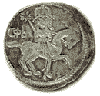
 Obverse - The ruler wears
imperial robes (divitision) with a large collar (maniak) edged with pearls
and closed imperial crown (stemma) . He is depicted on horseback, his horse
moving at a walk to the right and in his right hand he holds a scepter
surmounted by a cross. The two-part abbreviated Cyrillic imperial inscription
read СФb ZP.
Obverse - The ruler wears
imperial robes (divitision) with a large collar (maniak) edged with pearls
and closed imperial crown (stemma) . He is depicted on horseback, his horse
moving at a walk to the right and in his right hand he holds a scepter
surmounted by a cross. The two-part abbreviated Cyrillic imperial inscription
read СФb ZP. |
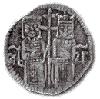 Obverse -The emperor
with a closed crown and the empress with a pointed crown, dressed in ceremonial
robes with a large collar (maniak) , together hold with one hand a monumental
cross with a double crosspiece standing between them. The other hand is
held against the chest. A Cyrillic inscription СФb ZP.
Obverse -The emperor
with a closed crown and the empress with a pointed crown, dressed in ceremonial
robes with a large collar (maniak) , together hold with one hand a monumental
cross with a double crosspiece standing between them. The other hand is
held against the chest. A Cyrillic inscription СФb ZP.
|
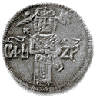 Obverse - The ruler wearing
a closed imperial crown (stemma) is depicted standing. He is dressed in
imperial regalia (divitision) with a stole (loros) decorated with rows
of pearls of precious gems. Two angels in flight place the imperial crown
on his head, symbolizig the divine origin of authority. In his right hand
he holds a scepter surmounted by a cross. A Cyrillic inscription
СФb ZP.
Obverse - The ruler wearing
a closed imperial crown (stemma) is depicted standing. He is dressed in
imperial regalia (divitision) with a stole (loros) decorated with rows
of pearls of precious gems. Two angels in flight place the imperial crown
on his head, symbolizig the divine origin of authority. In his right hand
he holds a scepter surmounted by a cross. A Cyrillic inscription
СФb ZP.
|
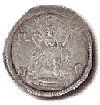
Reverse - The head
and shoulders of Christ with a granulated nimbus, Christ holding a scroll
in his left hand placed against his chest, and giving his blessing with
the right. The initials IC-XC at the height of his head. Letter seals N
- O in the lower left and right corners.
|
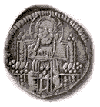
Reverse - Christ with
a nimbus is seated on a throne with a high back rest. He wears a long robe
(hiton) and mantle (himation) , one end hanging on his left. Both hands
against the chest, he holds the Gospels ornamented with five stones. No
initials in the field. |
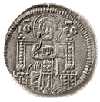
Reverse - Christ with
a granulated nimbus is seated on a throne with a high back rest. In both
hands he holds on his lap the Gospels ornamented with precious gems. The
initials IC - XC at the height of his head. |

